
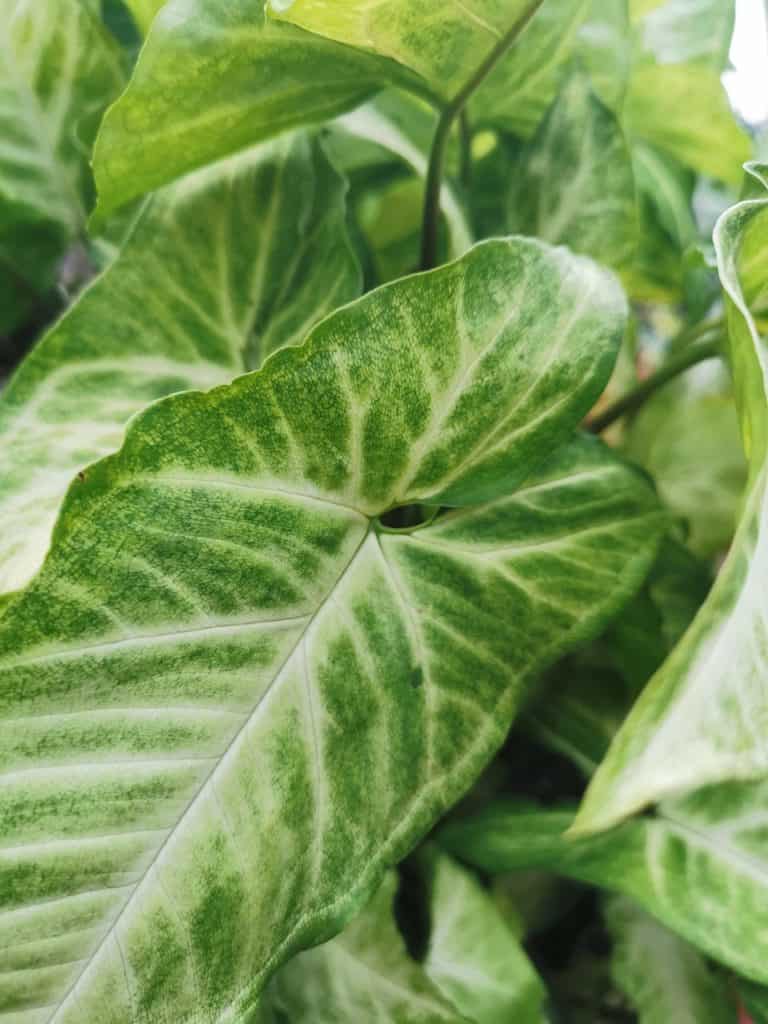
If you’re looking for a houseplant that genuinely changes over time, Syngonium is one of the most rewarding you can grow.
I’ve kept arrowhead plants for years, and there’s something quietly addictive about watching a neat little juvenile leaf eventually unfurl into something far more dramatic as the plant matures and begins to climb. No two stages look quite the same.
In this guide I’ve broken down 15 of the most popular and widely available Syngonium varieties, along with everything you need to identify them, care for them properly, and choose the right one for your home.
What Is a Syngonium Plant?
Syngonium (pronounced sy-no-nee-um) is a genus of tropical climbing plants belonging to the Araceae family, which also includes philodendrons, pothos, and peace lilies.
The genus contains around 36 recognised species, though the one you’ll almost always encounter as a houseplant is Syngonium podophyllum.
Native to tropical rainforests stretching from Mexico down through Central and South America, these plants grow naturally as climbers, using aerial roots to scale trees and work their way toward the light in the forest canopy.
The common name “arrowhead plant” comes from the distinctive shape of the juvenile leaves, which taper to two downward-pointing lobes at the base, closely resembling the head of an arrow.
You may also hear them called arrowhead vine, goosefoot plant, or nephthytis, though all three names refer to the same plant.
What makes Syngonium particularly interesting is how dramatically its appearance changes as it ages.
Young plants produce upright stems with simple, solid, arrow-shaped leaves.
As the plant matures and the stems begin to extend, the leaves start to split into lobes.
A fully mature specimen can produce leaves with five, seven, or even more distinct lobes, giving it a look that bears almost no resemblance to the neat little plant you first brought home from the garden centre.
This transformation from compact juvenile to sprawling climber is one of the most distinctive qualities in the genus.
How to Identify a Syngonium
If you’re trying to confirm whether the plant in front of you is a Syngonium, there are several reliable features to look for.
The most obvious is the arrow-shaped juvenile leaf, typically between 8 and 30 cm long, with two clearly downward-pointing lobes at the base.
The leaf surface is usually smooth and slightly glossy, though some varieties have a softer, more matte finish.
The petiole (leaf stalk) is long relative to the leaf itself, which gives young plants an open, airy appearance.
As the plant matures you’ll notice aerial roots beginning to form along the stems.
These brownish, cord-like roots allow the plant to grip supports and are a reliable indicator that you’re looking at a climbing aroid rather than something like a Caladium or Colocasia.
In terms of habit, young plants tend to grow upright with several leaves emerging from a central crown.
Once stems extend beyond around 30 to 40 cm, they will begin to trail or climb depending on whether they have something to attach to.
Syngonium rarely flowers indoors, but if it does, the flowers resemble a small, pale green or white peace lily bloom.
Syngonium vs Caladium: These two plants are frequently confused because both have arrow-shaped leaves and belong to the Araceae family.
The key difference is that Caladium grows from tubers and never develops a climbing habit, aerial roots, or lobed adult leaves.
Caladium leaves are also typically thinner, more translucent, and far more vividly coloured. If your plant is beginning to trail or showing early signs of leaf lobing, it is not a Caladium.
Syngonium Varieties at a Glance
Not sure which variety to grow? Use this table to compare the key characteristics before reading the full descriptions below.
| Variety | Main Colours | Light Needs | Growth Habit | Best For |
|---|---|---|---|---|
| Pink Allusion | Light green, pink veins | Bright indirect | Compact, upright | Pink lovers and beginners |
| White Butterfly | Green, creamy white centre | Medium to bright indirect | Vining or bushy with pruning | Trailing and hanging displays |
| Mini Pixie | Deep green, silver highlights | Low to medium indirect | Dwarf, compact | Small spaces and terrariums |
| Variegatum | Green with white splashes | Medium to bright indirect | Vining with age | Collectors who like irregular variegation |
| Exotic Allusion | Light green, creamy centre | Bright indirect (tolerates filtered) | Upright, compact | Rooms without bright windows |
| Bold Allusion | Soft green, pink veins | Medium to bright indirect | Compact, slow growing | Easy-care pink varieties |
| Green Gold | Green with yellow margins | Medium to bright indirect | Trailing, vining | Hanging baskets and high shelves |
| Cream Allusion | Cream green, subtle pink veins | Medium to bright indirect | Bushy, compact | Tabletops and coffee tables |
| Five Finger | Green with white patches, lobed | Medium to bright indirect | Vining, architectural with age | Statement plants on moss poles |
| Painted Arrow | Cream, white, and green mixed | Bright indirect | Upright, moderate | Bold variegation collectors |
| Holly | Silver-green, matte finish | Low to medium indirect | Compact, tidy | Offices and low-light rooms |
| Pink Splash | Pale green, pink flecks | Bright indirect | Compact | Collectors who want unusual markings |
| Emerald Gem | Deep emerald green, cream veins | Medium to bright indirect | Compact, moderate | Green plant enthusiasts |
| Trileaf Wonder | Pale to glossy deep green | Bright indirect | Fast growing, vining | Lush and full displays quickly |
| Albolineatum | Pale green deepening with age | Medium to bright indirect | Classic arrowhead shape | Beginners and classic collections |
15 Syngonium Varieties
1. Syngonium ‘Pink Allusion’
Pink Allusion is one of the most popular arrowhead varieties in the UK, and it earns that reputation.
The heart-shaped leaves are a soft, bright light green with a central zone that carries a gentle pink wash, and the veining throughout is a noticeably deeper rose-pink that stands out clearly against the lighter leaf surface.
The margins of the leaf fade to a slightly darker green, which gives the whole thing a clean, layered appearance rather than a flat, uniform colour.
It stays compact compared to more vigorous varieties, which makes it well suited to windowsills, side tables, and plant shelves where you want impact without bulk.
That said, it will begin to trail if left unpruned, and regular pinching back encourages a denser, bushier shape.
The key to keeping the pink tones vivid is good light. Pink Allusion needs bright indirect light to hold its colour properly.
In lower light the pink fades noticeably, leaving behind a fairly plain-looking light green plant. It does not need direct sun, but a well-lit east-facing windowsill is ideal.
If your plant starts losing its colour, moving it to a brighter position is almost always the fix.
2. Syngonium ‘White Butterfly’
White Butterfly is named for the distinctive shape and colouring of its leaves.
The central zone of each leaf is a soft creamy white or pale silver that bleeds outward into medium green at the margins, and the overall outline of the leaf, with its two flared basal lobes, genuinely does suggest a pair of wings when viewed straight on.
It’s one of those varieties that catches the eye from across a room.
It is one of the more versatile Syngoniums in terms of how you choose to display it. Left to trail, it looks elegant cascading from a shelf or hanging basket.
Given a moss pole or trellis to climb, it develops noticeably larger leaves and, eventually, begins to show the characteristic lobing of a maturing arrowhead plant. Kept in a pot with regular pruning, it stays compact and bushy.
In terms of care, White Butterfly is one of the most forgiving varieties. It adapts well to moderate indirect light, though the contrast between the white and green portions is sharper and more attractive in brighter conditions.
It tolerates occasional underwatering better than many variegated varieties, making it a good choice for anyone who is still building confidence with houseplant care.
3. Syngonium ‘Mini Pixie’
Mini Pixie is genuinely miniature by Syngonium standards. Where most arrowhead varieties will eventually trail or put on significant size, Mini Pixie stays tightly compact with small, neat, heart-shaped leaves that rarely exceed a few centimetres in width.
The foliage is a deep, glossy green with attractive silver highlights dusted across the surface, which catches the light nicely and prevents the plant from looking dark or heavy despite its compact habit.
Its small size makes it a natural choice for plant shelves, terrariums, and grouped arrangements where you want a tidy, detailed plant that doesn’t overwhelm neighbouring specimens.
It also works well on a desk or bathroom windowsill where space is genuinely limited.
One of Mini Pixie’s best qualities is its tolerance of lower light. Because the leaves are predominantly deep green rather than heavily variegated, the plant doesn’t struggle in dimmer conditions the way that lighter-coloured varieties do.
It won’t grow as fast in low light, but it will hold its appearance far better than something like Pink Splash or Painted Arrow would in the same position.
4. Syngonium ‘Variegatum’
Variegatum is a classic cultivar and one of the most striking examples of irregular variegation in the genus.
The leaves emerge heart-shaped in a fresh green with white splashes, blotches, and patches that vary from leaf to leaf.
No two leaves look identical, which gives the plant a dynamic, constantly evolving quality that many collectors find genuinely engaging.
As the plant matures and stems begin to extend, the leaf shape gradually transitions into a more defined arrowhead form, and eventually into the lobed adult foliage typical of a climbing Syngonium.
The white portions of the leaf, being less capable of photosynthesis than the green, mean the plant grows a little more slowly than solid green varieties, but this is a worthwhile trade-off for the visual interest it provides.
Keeping the white variegation crisp and bright requires consistent bright indirect light.
In lower light conditions, new growth tends to emerge with proportionally less white and more green as the plant compensates, and over time the plant can begin to look quite different from when you first bought it.
If you want to maintain bold variegation, a well-lit spot is not optional for this variety.
5. Syngonium ‘Exotic Allusion’
Exotic Allusion sits at the more subtle end of the Syngonium spectrum, and it’s all the better for it.
The leaves are a soft lime green with a creamy white wash concentrated toward the centre, transitioning to a slightly darker, cooler green at the margins. The effect is a layered, almost luminous quality that shows up particularly well in a bright position near a window.
The plant stays upright and compact, which makes it an excellent choice for spaces that don’t have the room for a trailing or vining specimen.
It performs particularly well on desks and in office environments, where it benefits from the consistent temperature and the kind of filtered daylight that comes through blinds or a north-facing window.
Unlike more vivid pink or white variegated varieties, Exotic Allusion holds its appearance reasonably well even in less than ideal light, making it a practical as well as a beautiful plant.
6. Syngonium ‘Bold Allusion’
Bold Allusion is arguably the most easygoing variety in the Allusion series.
The leaves are broadly oval and slightly softer in texture than some of the glossier varieties, with a fresh light green base and delicate pink veining running throughout the leaf surface.
The effect is subtle rather than dramatic, which means it fits into a wide range of décor styles without demanding attention in the way that a more boldly variegated plant would.
What sets Bold Allusion apart practically is how forgiving it is about light.
It holds its pink colouring reasonably well even in moderate indirect light, which is unusual for a pink Syngonium.
Most pink varieties lose their colour quickly if light is insufficient, but Bold Allusion is noticeably more tolerant.
Its growth is also slow to moderate, meaning it won’t take over a shelf arrangement the way that faster varieties can.
If you’ve previously struggled to maintain the pink tones on a Syngonium and are looking for a more reliable option, Bold Allusion is consistently the most recommended variety for lower-maintenance situations.
7. Syngonium ‘Green Gold’
Green Gold is one of the few Syngonium varieties that genuinely looks its best when it trails rather than sits upright.
The leaves are a rich, deep green with bold yellow margins and yellow-tinged venation throughout, a combination that creates a bright, warm effect that catches the light beautifully.
When stems cascade over the edge of a hanging basket, a tall pot on a shelf, or a macramé hanger, the contrast between the deep green centres and the glowing yellow edges is particularly striking.
The plant produces aerial roots readily as the stems extend, which also means it can be trained upward on a moss pole or trellis if you prefer a climbing display.
Regular pruning keeps it bushy if a trailing habit isn’t what you want, though the plant does need to put on some length before it becomes truly dramatic.
In terms of light, Green Gold is fairly adaptable. It performs well in medium to bright indirect light, and unlike many variegated varieties, the yellow colouring holds reasonably well even if light levels drop slightly.
Direct sun should still be avoided as it will bleach the leaf margins and cause the yellowing to become irregular and patchy rather than clean and even.
8. Syngonium ‘Cream Allusion’
Cream Allusion is quietly lovely in a way that works in almost any indoor setting.
The leaves are medium-sized with a soft cream-green colouring across most of the surface, and subtle pink veining runs through the leaf that is visible on close inspection without being immediately obvious from a distance.
The plant is naturally bushy and dense rather than vining, which gives it a well-organised, tailored appearance that requires minimal intervention to maintain.
Unlike some of the more vivid Allusion varieties that need careful placement to look their best, Cream Allusion is tolerant enough of moderate light that it can be used as a background plant or a complement to bolder specimens without the risk of it deteriorating quickly.
Its compact size also makes it one of the best choices for coffee tables, bathroom shelves, or anywhere you need something contained and well-behaved.
It handles lower humidity better than most of the pink varieties in the genus, which makes it practical for centrally heated UK homes where indoor humidity often drops significantly during the winter months.
9. Syngonium ‘Five Finger’
Five Finger is one of the most architecturally interesting Syngoniums you can grow, though you will need some patience to see it at its best.
Young plants look similar to most other arrowhead varieties, producing simple heart-shaped leaves with white patches and green venation.
The transformation happens as the plant matures and the stems begin to extend, at which point the leaves start to develop lobes.
A fully established specimen can produce leaves with two, four, five, or six distinct lobes depending on the growth conditions, giving the plant a deeply sculptural quality that looks unlike anything else in the genus.
The common name comes from the five-lobed adult foliage that resembles an outstretched hand, though the number of lobes is variable and not always precisely five.
Training the plant up a moss pole significantly encourages this development, as the climbing habit and the presence of a support seem to accelerate the transition from juvenile to adult foliage.
Five Finger is best appreciated as a statement plant rather than a compact table piece.
Given time and a proper support, it develops into an impressive specimen that draws attention without the maintenance demands of more delicate variegated varieties.
10. Syngonium ‘Painted Arrow’
Painted Arrow is one of the most boldly variegated Syngoniums in regular cultivation.
Each leaf carries a mix of cream, white, and green tones distributed irregularly across the surface, almost as though the leaf has been brushed by hand.
Because the variegation pattern shifts from leaf to leaf, the plant always has a spontaneous, painterly quality rather than the more predictable patterning of varieties like White Butterfly.
The consequence of this heavy variegation is that the plant needs consistent bright indirect light to maintain the intensity of its pale markings.
In lower light conditions the cream and white sections dull noticeably, and over time new leaves emerge with progressively more green as the plant attempts to compensate for reduced photosynthesis.
Reverting is a genuine risk with Painted Arrow if light levels aren’t maintained, and it is worth positioning it as close to an east-facing window as possible.
It is worth noting that heavily variegated leaves are also more prone to damage from cold draughts, dry air, and inconsistent watering than a solid green leaf would be.
Painted Arrow rewards a stable, well-lit environment and repays the attention with foliage that is genuinely difficult to find in anything else at a similar price point.
11. Syngonium ‘Holly’
Holly is a compact, tidy variety with small, neat leaves in a distinctive silver-green shade.
The foliage has a slightly matte, almost velvety quality compared to the glossier varieties in the genus, and the silver tones give the plant an elegant, understated look that works particularly well in contemporary interiors where more vivid colours might feel out of place.
Its most significant practical advantage is its tolerance of lower light.
Because the leaves are predominantly a deep silver-green rather than pale or white-variegated, Holly can be maintained in positions that would cause most other varieties to deteriorate.
It is one of the most commonly recommended arrowhead varieties for north-facing rooms, hallways, and office environments where natural light is limited but you still want living greenery.
Growth is slow and tidy, with the plant rarely requiring pruning to maintain a compact shape.
It is a genuinely low-maintenance variety that suits anyone looking for a long-term, unfussy houseplant without sacrificing visual appeal.
12. Syngonium ‘Pink Splash’
Pink Splash is visually distinctive in a way that’s hard to convey until you see it in person.
The leaves are a pale, almost cream-green base colour covered in petite pink flecks, spots, and splashes that are distributed irregularly across the surface.
The overall effect is more playful and spontaneous than the structured veining of Pink Allusion or the uniform blush of Bold Allusion, and the variation between individual leaves means the plant always looks slightly different as new growth emerges.
The key requirement for Pink Splash is good light. The pink colouring in this variety is particularly sensitive to light levels, and in anything less than bright indirect light the pink tones fade rapidly and completely, leaving behind a pale, washed-out green that is quite unremarkable.
For the best results, place it as close to a bright window as possible without exposing it to direct sun, which will cause bleaching and brown patches on the paler leaf sections.
Pink Splash tends to stay reasonably compact, which makes it suitable for windowsills and plant shelves, but it does benefit from regular rotation to ensure even light distribution across all of its leaves.
13. Syngonium ‘Emerald Gem’
Emerald Gem is the arrowhead plant for those who prefer lush green foliage over variegation.
The leaves are a deep, polished emerald green with cream-coloured veining that creates an attractive quilted or ribbed texture across the surface.
The colour is rich and consistent, with a slight gloss that makes individual leaves look healthy and well-defined from a distance.
The plant stays compact and its growth rate is moderate rather than vigorous, which means it maintains a tidy shape without constant attention.
Unlike variegated varieties, Emerald Gem is notably more tolerant of lower light without any visible decline in leaf quality, which makes it one of the most versatile arrowhead varieties for rooms that don’t receive consistent bright light throughout the day.
It is a good choice for collectors who want the characteristic arrowhead leaf shape and the satisfying growth habit of the genus without the additional care requirements that come with maintaining delicate white or pink variegation.
Emerald Gem is the kind of plant that simply gets on with things quietly and looks better the longer you keep it.
14. Syngonium ‘Trileaf Wonder’
Trileaf Wonder is one of the fastest-growing varieties in the genus, and it shows.
Young plants produce pale, almost translucent juvenile leaves with a fresh lime quality that deepens and becomes glossier as each leaf fully matures.
The transition from the soft, pale new growth to the rich, polished mature leaf happens relatively quickly, and the plant puts on new leaves at a noticeably faster rate than the compact Allusion varieties during the active growing season.
The name refers to the three-lobed leaf shape that becomes more pronounced as the plant develops, though the lobing is subtle in younger specimens and becomes more defined as the stems extend and the plant moves into its adult growth phase.
Trileaf Wonder performs best in bright indirect light, which encourages the fastest growth and the deepest, glossiest leaf colour.
In lower light it will still grow, but the rate slows considerably and the leaves tend to remain paler for longer.
If you want a Syngonium that fills out a display or climbs a support quickly, this is consistently one of the best options available.
15. Syngonium ‘Albolineatum’
Albolineatum is one of the most classic-looking arrowhead varieties you can grow, and for many people it’s exactly what they picture when they think of a Syngonium.
The leaves are well-defined arrowheads in pale green with a lighter, almost silvery central zone that gives the leaf a clean two-tone quality.
As the plant matures the pale green deepens to a richer, more saturated shade, so the plant’s overall appearance becomes bolder and more established-looking over time.
It is a reliable, unfussy variety that doesn’t demand the bright light conditions required by heavily white or pink variegated cultivars.
The arrowhead shape is particularly well-defined and consistent in Albolineatum, making it a good representative example of the genus for anyone who wants to understand what Syngonium is about before branching out into more unusual varieties.
Growth is moderate and steady. The plant won’t race away from you the way Trileaf Wonder might, but it won’t sit still for months either.
It is the kind of variety you can buy, place in a sensible spot, water correctly, and enjoy for years without it presenting any particular challenges.
How to Care for Syngonium
Most Syngonium varieties share the same core care requirements, so getting these right will serve you well regardless of which variety you choose to grow.
Light
Syngonium thrives in bright indirect light and tolerates moderate and even low light significantly better than most houseplants.
Direct sun will scorch the leaves of all varieties, so avoid placing any arrowhead plant on a south-facing windowsill in summer in the UK.
The most important distinction to understand is that variegated varieties need considerably more light than solid green ones.
Anything with significant white, cream, or pink colouring requires bright indirect light to maintain its colour contrast.
If a pink or white variety starts pushing out plain green new growth, insufficient light is almost always the cause. Moving it closer to a window will usually reverse the trend within a few weeks.
Solid green varieties like Holly, Emerald Gem, and Albolineatum are the most tolerant of lower light and are your safest choices for north-facing rooms or positions away from windows.
Watering
Water your Syngonium when the top 2 to 5 cm of compost feels dry to the touch. The plant prefers consistently moist but never waterlogged soil.
During the active growing season in spring and summer, this may mean watering every five to seven days in a well-lit position.
In autumn and winter, growth slows considerably and the compost dries out much more slowly, so watering frequency should be reduced accordingly.
Overwatering is the most common cause of Syngonium decline. Yellowing leaves combined with soggy compost at the base of the pot almost always indicates too much water rather than too little.
Allow the top layer of soil to dry before watering again, and always ensure the pot has adequate drainage holes so water doesn’t pool at the roots.
Brown, crispy leaf edges are generally a sign of underwatering or low humidity rather than overwatering.
If the soil feels dry and the leaf edges are crisping, increase your watering frequency slightly and consider the humidity tips below.
Temperature
Syngonium grows well in the temperature range typical of UK homes, broadly between 15 and 28°C.
The critical point is that these plants dislike cold draughts, fluctuating temperatures, and anything approaching frost.
Keep them away from windows that are left open overnight, external doorways, and particularly from the cold glass of single-glazed windows during winter, where temperatures can drop low enough overnight to cause leaf damage.
The minimum safe temperature is around 10°C, below which the plant will show visible stress and may begin to drop leaves.
Syngonium is not hardy outdoors in any part of the UK and should be treated as a houseplant year-round.
Humidity
As plants native to tropical rainforests, Syngoniums appreciate higher humidity than a typical centrally heated UK home provides, particularly during winter when radiators are running and indoor air becomes noticeably drier.
The ideal range is around 50 to 60 percent relative humidity, which is achievable with a small room humidifier or by standing the pot on a tray of damp pebbles so that evaporation increases the local humidity around the plant.
Grouping several plants together also raises the humidity in the immediate area through the natural process of transpiration.
Misting the leaves can help in the short term but has a limited ongoing effect since the moisture evaporates quickly and the benefit doesn’t last more than an hour or two.
Brown leaf tips are the most common symptom of insufficient humidity, particularly on variegated varieties where the paler leaf sections are more sensitive to dry air.
Feeding
Feed your Syngonium monthly during spring and summer using a balanced liquid fertiliser diluted to half the recommended strength.
This supports the active growth period without the risk of over-fertilising, which can cause leaf burn and salt buildup in the compost.
There is no need to feed during autumn and winter when the plant’s growth slows significantly and its nutritional demands drop.
Repotting
Syngonium generally needs repotting every one to two years, with spring being the best time to do it.
The signal to repot is roots beginning to circle the base of the pot or emerge from the drainage holes.
Move up by one pot size only, as an overly large pot holds more moisture than the roots can absorb and increases the risk of root rot.
A well-draining compost works best, and adding a small amount of perlite to standard houseplant mix improves aeration around the roots.
How to Propagate Syngonium
Syngonium is one of the easiest houseplants to propagate, and spring through early summer is the best time to do it because the combination of warmer temperatures and longer days encourages roots to establish quickly.
The method is simple. Take a stem cutting just below a node, which is the small bump or joint where a leaf meets the stem.
Your cutting should include at least one healthy leaf and ideally one or two nodes to give it the best chance of success.
Remove any leaves from the lower part of the cutting so that no foliage will be submerged.
You can root the cutting in a glass of water, replacing the water every three to four days to prevent bacteria from building up.
Once the roots reach three to five centimetres in length, the cutting is ready to pot up into moist compost.
Alternatively, you can root directly into a small pot of moist compost or perlite, keeping it consistently moist until new growth appears, which indicates that the roots have established.
In warm conditions with good indirect light, roots typically appear within two to four weeks.
Avoid placing propagating cuttings in direct sun, as this causes the leaves to lose moisture faster than the rootless stem can replace it.
Is Syngonium Toxic?
Yes, Syngonium is toxic to humans, dogs, and cats. All parts of the plant contain insoluble calcium oxalate crystals, which cause immediate irritation to the mouth, tongue, and throat when chewed or swallowed.
The crystals insert themselves into the soft tissues of the mouth and digestive tract, causing intense burning, swelling, and discomfort.
In pets, symptoms of ingestion include excessive drooling, pawing at the mouth, vomiting, and in severe cases, swelling that can partially obstruct the airway.
In humans, particularly young children, symptoms are similar and can include oral burning, stomach pain, and nausea.
If ingestion occurs in a child, contact NHS 111 immediately. If a pet has chewed on the plant, contact your veterinarian as soon as possible.
Place all Syngonium varieties out of reach of children and animals as a precaution, regardless of which variety you grow.
Does Syngonium Clean the Air?
Syngonium has been included in air quality research, most notably in studies associated with NASA’s Clean Air Study, which identified a range of common houseplants as being capable of reducing certain volatile organic compounds including benzene, formaldehyde, toluene, and xylene from indoor air.
Syngonium was among the species identified as beneficial.
It is worth being realistic about the scale of this benefit in a typical home.
The conditions used in laboratory studies are different from the open, ventilated rooms of a real house, and you would need a significant number of plants to replicate the air quality improvements measured in controlled conditions.
That said, there is a genuine, evidence-based reason to believe that Syngonium contributes positively to indoor air quality rather than purely in the realm of marketing claims.
Growing it for this reason alongside the obvious visual benefits is entirely reasonable.
Common Syngonium Problems and How to Fix Them
Yellowing leaves most commonly indicate overwatering or poor drainage.
Check that the compost has had a chance to partially dry between waterings, that the pot is not sitting in standing water, and that the drainage holes are clear.
If the roots smell unpleasant when you investigate, root rot may have set in and you will need to remove damaged roots and repot into fresh, dry compost.
Brown, crispy leaf edges are almost always a humidity or underwatering issue. Increase watering frequency slightly and consider steps to raise local humidity, such as grouping plants together or using a pebble tray.
Leggy, thin growth with long spaces between leaves indicates insufficient light. The plant is stretching toward the nearest light source. Move it to a brighter position and the next set of new leaves will emerge more compact and better formed.
Loss of variegation on coloured varieties is a light problem. When a pink, cream, or white variety begins pushing out predominantly green new leaves, it is a sign that light levels are too low for the plant to maintain its variegation. Move it closer to a window and monitor the next two to three leaves.
Brown spots on pale leaf sections can indicate that humidity is too low, particularly for more delicate variegated varieties. It can also be a sign of inconsistent watering causing the plant stress. Stabilising both factors usually resolves the issue.
Frequently Asked Questions
What is the most common Syngonium variety? Syngonium podophyllum is the most widely grown species, and within it the cultivars most commonly found in UK garden centres are White Butterfly and Pink Allusion.
These are the varieties you’re most likely to encounter on a standard houseplant table, and both are excellent starting points for anyone new to the genus.
How fast does Syngonium grow? In good conditions during spring and summer, Syngonium can produce a new leaf every one to two weeks.
Growth slows considerably in autumn and winter in response to shorter days and lower temperatures.
Trileaf Wonder and White Butterfly are among the faster-growing varieties, while the compact Allusion series plants tend to grow more slowly.
Can Syngonium grow in low light? Yes, it is one of the better-performing houseplants in lower light positions.
Solid green and silver-green varieties like Holly, Emerald Gem, and Mini Pixie are the most tolerant of reduced light.
Heavily variegated varieties with significant white, cream, or pink colouring will lose their colour contrast in low light over time and are better suited to brighter conditions.
Does Syngonium need a moss pole? It doesn’t require one, but it benefits significantly from having something to climb.
Providing a moss pole or trellis encourages the plant to produce larger leaves and, in more vigorous varieties, to develop the lobed adult foliage that makes mature specimens so distinctive.
Without a support the plant will simply trail, which is also attractive, but the leaves tend to stay in their juvenile arrowhead form indefinitely.
Can Syngonium grow in water? Stem cuttings root readily in water and can be maintained in water for extended periods.
Long-term water growing is possible but produces slower growth than soil cultivation.
If keeping a cutting or small plant in water, use a clean, opaque container to reduce algae growth, keep it out of direct sun, and refresh the water weekly.
Is Syngonium the same as Caladium? No. Both plants have arrow-shaped leaves and belong to the Araceae family, which causes frequent confusion, but they are different genera with different growth habits.
The simplest way to tell them apart is by the habit of the mature plant. Syngonium develops lobed adult leaves and a climbing or trailing habit with aerial roots.
Caladium grows from tubers, stays upright, never lobes, never climbs, and typically has far thinner, more translucent leaves in much more vivid colours.
If your plant is beginning to trail or has small root-like growths along the stems, you have a Syngonium.
UK Reader Note
Syngonium is not hardy outdoors in any part of the UK and should be treated as a houseplant throughout the year.
It has no RHS hardiness rating for outdoor cultivation and would be classified H1a, meaning it requires frost-free conditions and is best kept above 15°C at all times.
White Butterfly and Pink Allusion are widely stocked in most UK garden centres and houseplant retailers.
More unusual varieties like Five Finger, Painted Arrow, and Green Gold may require specialist online retailers, but availability has improved considerably in recent years as demand for arrowhead plants has grown.
The most common challenge for Syngonium in the UK is the combination of low winter light and dry central heating air.
Placing the plant near an east-facing window and using a pebble tray or humidifier during the heating season will make a significant difference to how it performs between October and March.
Final Thoughts
Whether you are after a compact, easy-care desk plant, a trailing specimen to cascade from a high shelf, or something with genuinely striking pink or cream variegation that will change appearance as it matures, there is a Syngonium variety well suited to what you have in mind.
The genus rewards some attention to the basics. Get the light right for variegated types, water carefully rather than generously, keep the plant away from cold draughts, and consider the humidity during winter.
Do those things, and you will have a plant that grows, changes, and looks better the longer you keep it.
Before you go, you might also enjoy:
- 16 Great Pothos Varieties to Brighten Up Your Home
- Pothos vs Philodendron: Similarities, Differences & More
Hi, I'm Matt,
An amateur gardener with a houseplant habit that got slightly out of hand.
I started Bean Growing to share what I've learned from a few years of trial, error, and the occasional dead plant.
I grow a mix of houseplants and outdoor shrubs in the UK but try to expand my knowledge to the US. I try to write about what actually works